Complete Guide to Traction Batteries: types, cycles, industrial applications, and how to choose the ideal one
A traction battery is the deep-cycle battery that powers industrial electric equipment: forklifts, pallet trucks, electric pallet jacks, aerial work platforms, and even shunting locomotives. It is designed to discharge deeply throughout an entire work shift and then recharge, every day.
No other lead-acid battery works as hard: daily deep discharge, vibration, movement, and often two- or three-shift operation. That is why the internal construction of a traction battery is different from anything found in automotive or stationary batteries.
This guide explains how a traction battery works, where it is used, how to size voltage and capacity for each shift, and which maintenance practices determine the service life of the investment.
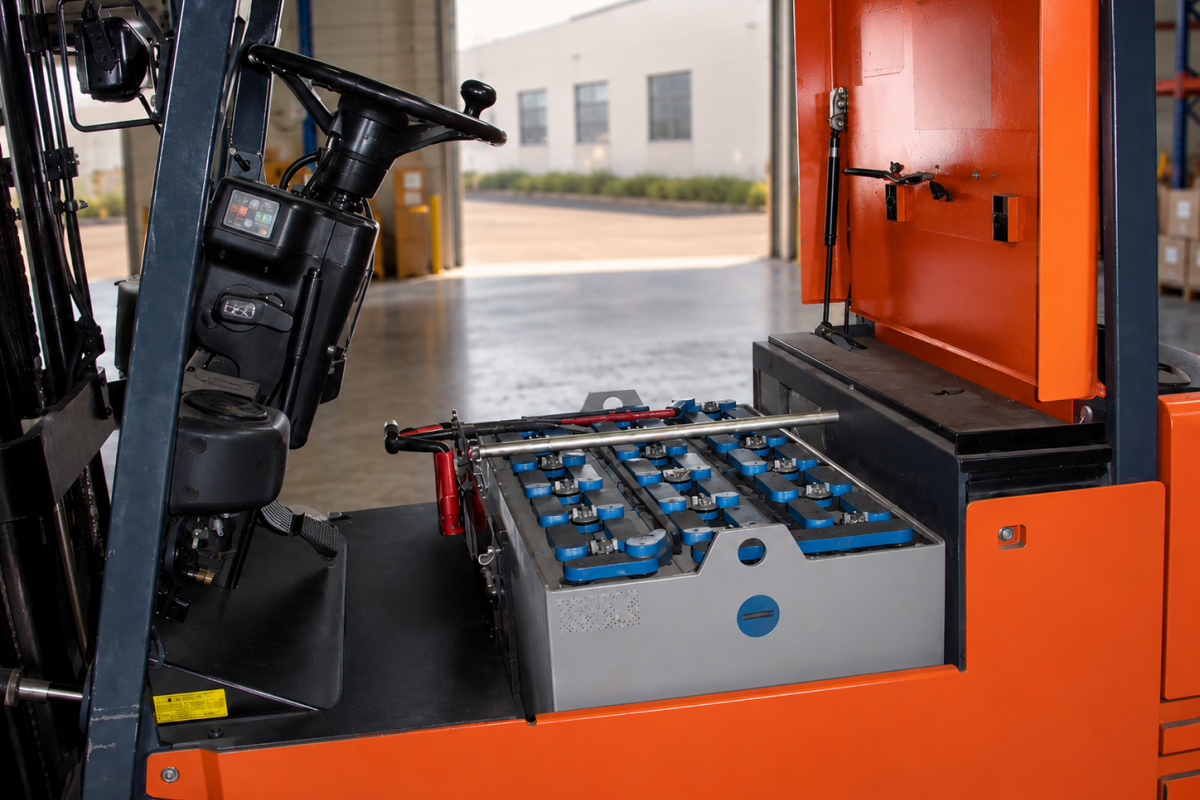
What is a traction battery and how does it work?
A traction battery converts chemical energy into electrical energy for propulsion and work - in a forklift, it powers the travel and lifting motors, and its own weight also acts as the equipment's counterweight.
The assembly is built from individual elements (2V cells) or monoblocks combined to reach the equipment's nominal voltage: 24V, 36V, 48V, or 80V. The plate grids use high-antimony alloys specifically developed to withstand high depths of discharge, cycle after cycle.
Where are traction batteries used?
- Electric forklifts: the heart of intralogistics in warehouses and distribution centers.
- Electric pallet trucks and pallet jacks: load handling at docks and in aisles.
- Aerial work platforms: working at height with stable power throughout the workday.
- Floor sweepers and scrubbers: professional cleaning of large areas.
- Shunting locomotives: 32V and 64V sets, from 140Ah to 440Ah, used in mining, export, and distribution operations.
- Light electric vehicles, such as golf carts and low-speed utility vehicles.
What types of traction batteries are there?
Traction batteries are organized by format and assembly: individual 2V cells mounted in custom metal trays sized for the equipment compartment, and monoblocks - polypropylene cases with sealed covers containing the cells, used in smaller equipment.
The dominant technology is vented lead-acid with liquid electrolyte, which requires periodic topping-up with demineralized water - an industrial relative of deep-cycle marine batteries, but designed for far more severe operating profiles. Differences in construction and plate design follow the compartment and application of each piece of equipment.
How do you choose the right traction battery?
Four definitions specify the battery: the equipment's nominal voltage (24V, 36V, 48V, or 80V), enough capacity in Ah to cover shift consumption with a safety margin, the shift pattern - which determines spare batteries and the charging routine - and the compartment dimensions and weight, since the battery also serves as a counterweight.
Getting any of the four wrong is costly: too little capacity for the shift means equipment downtime; a battery larger than the compartment simply will not fit. That is why specification is an application-engineering task carried out equipment by equipment.
How does the charging routine work in the operation?
In a single-shift operation, the routine is simple: the equipment works, the battery discharges, and it recharges overnight. In two- or three-shift operations, charging-room logistics come into play: spare batteries, scheduled swaps between shifts, and cooling time after charging - a freshly charged battery heats up, and returning it to work while hot shortens its life.
So-called opportunity charging - partial recharges during a lunch break, for example - changes the thermal and cycling profile of the battery. It can be viable, but it depends on the charger and the operating routine; application engineering evaluates each case individually.
What is the difference between traction, stationary, and automotive batteries?
At Tudor, all three technologies are part of the portfolio: also learn about the stationary battery line for fixed applications.
How does maintenance determine service life?
- Recharge after each period of use: lead-acid batteries do not have a memory effect.
- Top up with demineralized water only after a full charge, covering the plates without overfilling.
- Perform equalization two to three times a year, or whenever there is a density variation between cells.
- Use a multistage charger with an initial current between 10% and 15% of the C20 capacity.
- Monitor electrolyte density - the full-charge reference is 1.265 g/cm³.
- Charge in a ventilated room, away from flames and sparks, avoiding temperatures above 40°C - heat accelerates wear in any lead-acid battery.
What are the signs that a traction battery is reaching the end of its service life?
- Decreasing autonomy: the battery can no longer complete the shift it used to complete.
- Persistent density differences between cells, even after equalization.
- Excessive heating during charging.
- Abnormal water consumption in specific cells.
- Performance drops in the forklift's lifting movements.
Monitoring these signs turns replacement into a planned maintenance decision - avoiding the mistakes that reduce battery lifespan - with the budget approved and a new battery arriving before the equipment stops.
How does Tudor support industrial operations?
The Tudor Traction Battery line combines high-antimony grids, polypropylene monoblocks with sealed covers, reinforced H.D. connectors, and high-strength plate welding. The factory provides application engineering to specify each piece of equipment, and quality management is ISO 9001 certified - with ISO 14001 and IATF 16949 at the Bauru, São Paulo facility - as well as battery reverse logistics in accordance with CONAMA Resolution 401/2008.
Conclusion
A traction battery is a production asset: when correctly specified and maintained, it ensures forklifts and equipment complete every shift without stopping. Discipline in charging, water replenishment, and equalization is what turns the right specification into years of operation.
To specify the traction battery for your operation, access which traction battery to choose and request a quote from a Tudor specialist via WhatsApp.
And to keep learning, follow the technical content on the Tudor blog.
Frequently Asked Questions
What is a traction battery?
It is a deep-cycle battery designed to power industrial electric equipment, such as forklifts and pallet trucks, withstanding daily deep discharges followed by recharging.
What voltage does a traction battery use?
The voltage follows the equipment: 24V, 36V, 48V, or 80V, assembled from 2V cells or combined monoblocks. Shunting locomotives use 32V and 64V sets.
How many cycles does a traction battery last?
It depends on depth of discharge, shift pattern, and maintenance discipline. Correct charging, timely demineralized-water replenishment, and periodic equalization allow the battery to reach its designed service life.
What is the difference between a traction battery and a stationary battery?
A traction battery powers equipment and operates in deep cycles with vibration and movement; a stationary battery powers fixed installations in float mode or backup cycles. Their internal constructions are different.
What maintenance does a traction battery require?
Recharging after use, topping up with demineralized water after a full charge, periodic equalization, electrolyte-density monitoring, and a ventilated charging room.
Read also
What Is a Traction Battery and Where Is It Used?
A traction battery is a deep-cycle battery designed to power industrial electric equipment: forklifts, pallet trucks, electric pallet jacks, aerial work platforms, and shunting locomotives. It discharges deeply during the work shift and then recharges, every day. If an automotive battery is a sprinter - extremely high current for seconds - a traction battery is a marathon runner: deep cycle taken to an industrial extreme, with the equipment moving and under vibration. In this article, you will understand how it is built, where it is used, and why maintenance determines the service life of this industrial asset.
Continue reading