What Is a Traction Battery and Where Is It Used?
A traction battery is a deep-cycle battery designed to power industrial electric equipment: forklifts, pallet trucks, electric pallet jacks, aerial work platforms, and shunting locomotives. It discharges deeply during the work shift and then recharges, every day.
If an automotive battery is a sprinter - extremely high current for seconds - a traction battery is a marathon runner: deep cycle taken to an industrial extreme, with the equipment moving and under vibration.
In this article, you will understand how it is built, where it is used, and why maintenance determines the service life of this industrial asset.
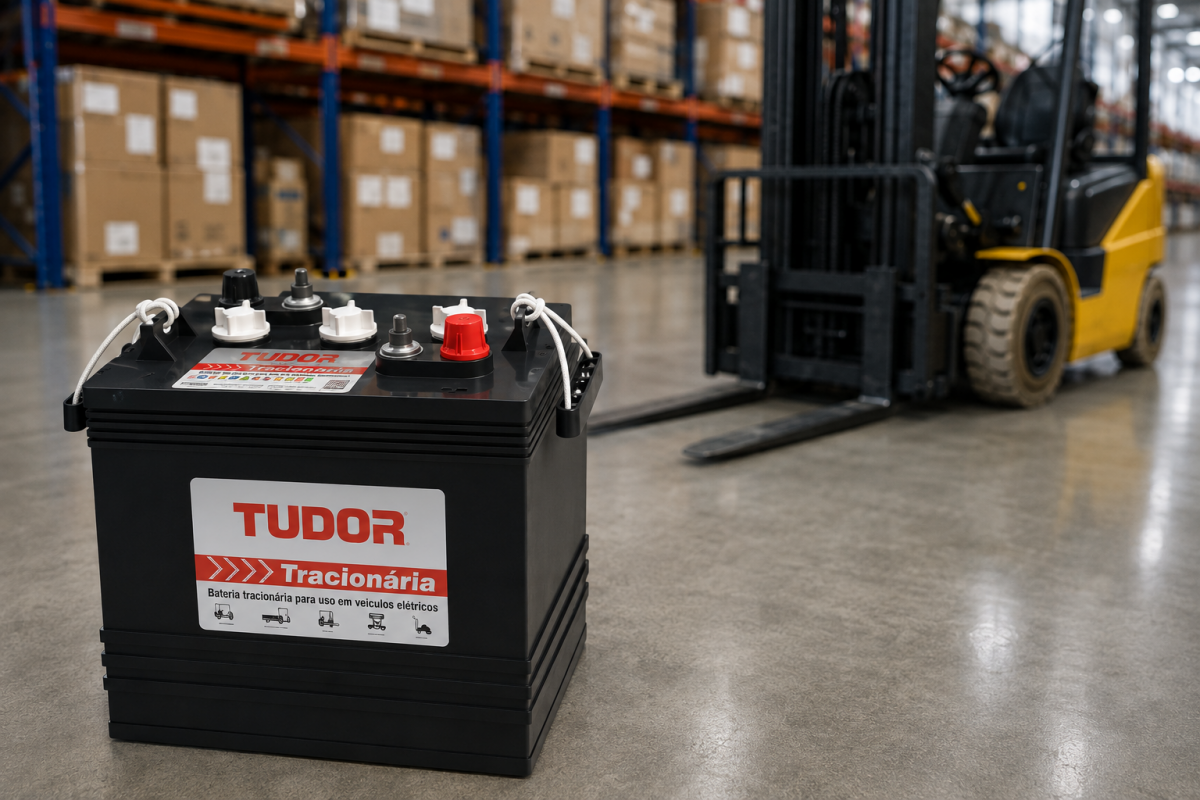
How does a traction battery work?
The assembly is built from 2V cells or monoblocks combined to reach the equipment's nominal voltage - 24V, 36V, 48V, or 80V. In a forklift, the battery powers the traction and lifting motors and also performs a mechanical role: its weight acts as the equipment's counterweight.
To survive daily deep discharge, the plate grids use high-antimony alloys, and the structure is reinforced: polypropylene monoblocks with sealed covers, reinforced connectors, and high-strength plate welding. Constant vibration is treated as a design premise, not an exception.
Where is a traction battery used?
- Electric forklifts in warehouses, industries, and distribution centers.
- Electric pallet trucks and pallet jacks for load handling.
- Aerial work platforms for working at height.
- Floor sweepers and scrubbers for large areas.
- Shunting locomotives: 32V and 64V sets, from 140Ah to 440Ah, used in mining, export, and distribution operations.
- Light electric vehicles, such as golf carts.
How is it different from other batteries?
A traction battery operates in deep cycles with movement and vibration; a stationary battery powers fixed installations in float operation; an automotive battery specializes in starting. Their three internal constructions are different - and interchanging them shortens the service life of any of them. The practical rule is simple: each construction for its intended job.
What is the daily routine with a traction battery?
The cycle repeats every workday: the equipment works the shift, the battery discharges to the designed limit, and then goes to the charging room - full recharge followed by cooling time before returning to service. In two- or three-shift operations, spare batteries rotate in so the equipment never has to wait.
This routine is also a dashboard for battery health: decreasing autonomy, heating during charging, or abnormal water consumption are warnings that something has moved outside the proper operating range - and heat is a declared enemy of any lead-acid battery.
Why is maintenance decisive?
A traction battery is a vented battery: it consumes water during the charging process and requires periodic topping-up with demineralized water, always after a full charge. Equalization - two to three times a year - corrects differences between cells, and electrolyte density (1.265 g/cm³ as the full-charge reference) is a gauge of the battery's health. Discipline in these routines is what allows the battery to reach its designed service life - without it, the mistakes that reduce battery lifespan are repeated on an industrial scale.
How long does a traction battery last?
Service life is measured in cycles - one cycle per workday in a typical operation. The final number depends on average depth of discharge, operating temperature, and above all maintenance discipline: timely demineralized-water replenishment, full recharging after use, and periodic equalization. Two identical batteries can differ by years of service life depending on this routine.
Who specifies a traction battery?
Specification is a joint effort between the operation and the manufacturer's application engineering team. The operation provides the equipment, nominal voltage, shift pattern, and compartment dimensions; engineering translates this into a cell or monoblock configuration, capacity, and charging routine. This process ensures the battery completes the shift - and fits the equipment.
How does Tudor support industrial operations?
The Tudor Traction Battery line combines high-antimony grids, polypropylene monoblocks, and reinforced H.D. connectors, with application engineering to specify voltage and capacity equipment by equipment - from pallet trucks to shunting locomotives. Quality is ISO 9001 certified, with ISO 14001 and IATF 16949 at the Bauru, São Paulo facility.
Conclusion
The traction battery is the silent engine of intralogistics: when correctly specified and maintained, it ensures every shift ends without equipment downtime. Understanding how it works is the first step toward buying correctly and operating better.
To specify the battery for your operation, access which traction battery to choose and request a quote from a Tudor specialist.
Continue exploring the topic by learning about the Tudor Traction Battery line in detail.
Frequently Asked Questions
What is a traction battery?
It is a deep-cycle battery designed to power industrial electric equipment, discharging deeply during the shift and then recharging.
Where is a traction battery used?
In forklifts, pallet trucks, electric pallet jacks, aerial work platforms, sweepers, shunting locomotives, and light electric vehicles.
What voltage does a traction battery use?
It follows the equipment: 24V, 36V, 48V, or 80V, made up of 2V cells or monoblocks. Locomotives use 32V and 64V sets.
Does a traction battery require maintenance?
Yes: topping up with demineralized water after a full charge, periodic equalization, and electrolyte-density monitoring, in accordance with the technical manual.
Can a traction battery be used in an internal-combustion forklift?
No - internal-combustion forklifts use a conventional starting battery. A traction battery is for electric equipment, where it is the energy source for propulsion and work.
Can I use a stationary battery in a forklift?
No. A stationary battery is not built for daily deep discharge with movement and vibration. A forklift should use only a traction battery.
Read also
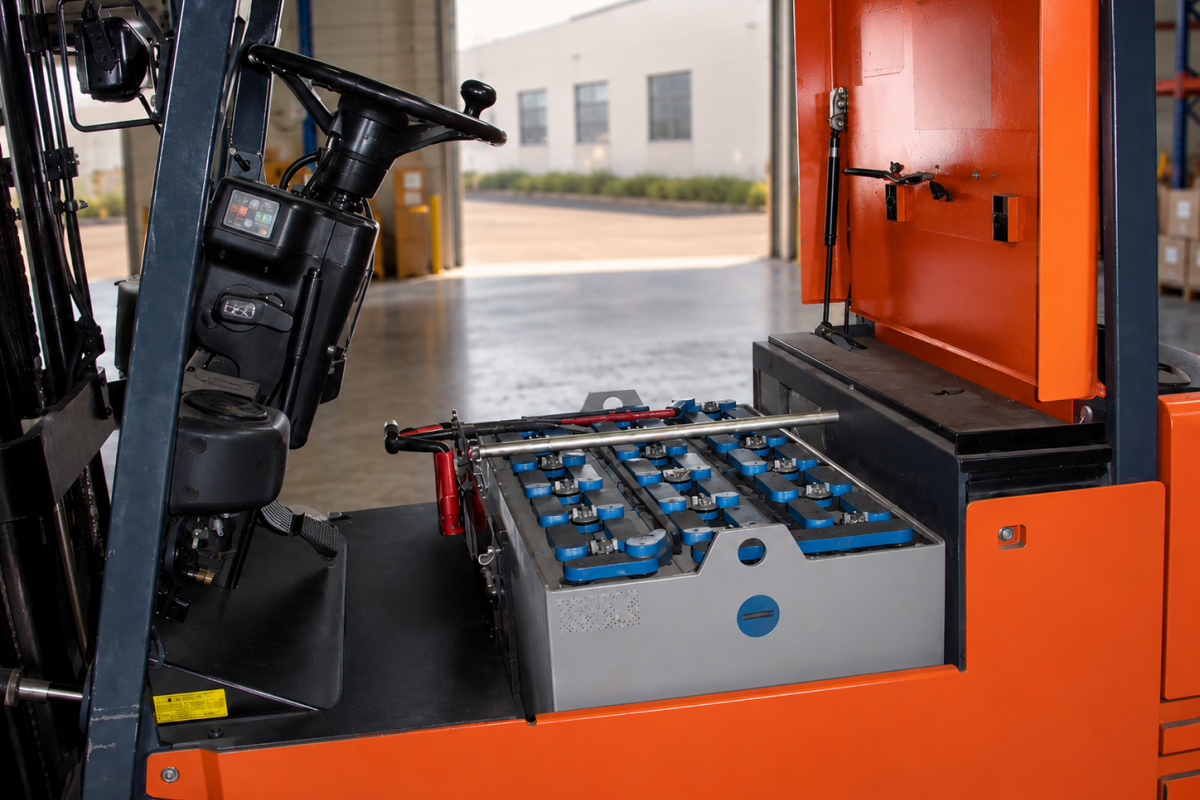
Complete Guide to Traction Batteries: types, cycles, industrial applications, and how to choose the ideal one
A traction battery is the deep-cycle battery that powers industrial electric equipment: forklifts, pallet trucks, electric pallet jacks, aerial work platforms, and even shunting locomotives. It is designed to discharge deeply throughout an entire work shift and then recharge, every day. No other lead-acid battery works as hard: daily deep discharge, vibration, movement, and often two- or three-shift operation. That is why the internal construction of a traction battery is different from anything found in automotive or stationary batteries. This guide explains how a traction battery works, where it is used, how to size voltage and capacity for each shift, and which maintenance practices determine the service life of the investment.
Continue reading