Stationary Battery for a UPS: How to Size the Required Runtime
To size the stationary battery for a UPS, add up the power of the protected equipment (W), define the desired runtime in hours, calculate the energy (Wh = W × hours), and convert it to capacity by dividing by the battery-bank voltage - applying margins for depth of discharge and temperature.
A UPS without a properly sized battery is an empty promise: it may keep the power on for minutes when the project needed an hour. The opposite also costs money - capacity far beyond what is needed is idle investment.
This guide walks through the calculation step by step, with a practical example and the mistakes that reduce real runtime.
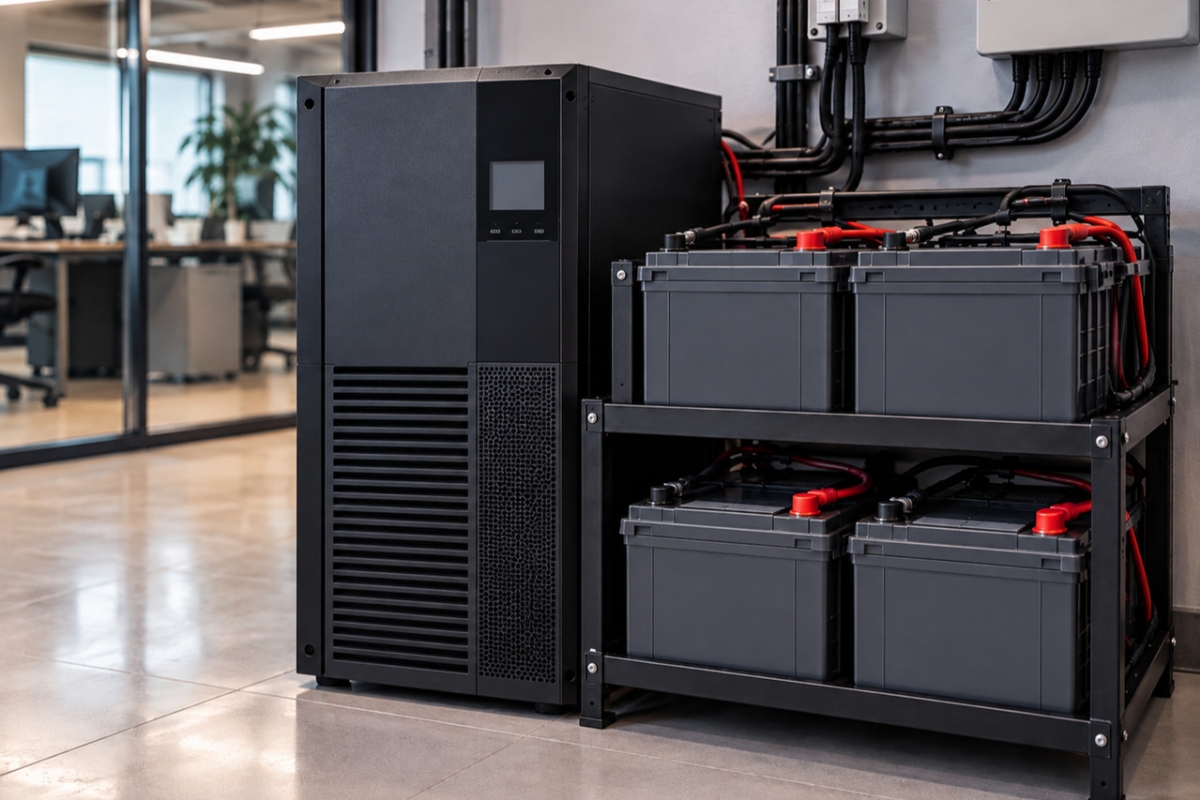
The role of the battery in a UPS
A UPS monitors the grid and, when power fails, transfers the load to the battery in milliseconds - the electronics do the switching, but the energy comes from the stationary battery, which lives in float mode: always charged, waiting for the moment it has to work. This is the classic application described in what is a stationary battery and what is it used for - and exactly the kind of work an automotive battery is not designed to do, as shown in the stationary battery vs. automotive battery comparison.
Sizing in four steps
- 1. Add up the actual power of the protected equipment: computers, servers, modem, cameras, automation (in watts).
- 2. Define the required runtime: minutes to shut down safely, or hours to ride through the outage.
- 3. Calculate the energy: Wh = total power × runtime hours.
- 4. Convert to capacity: divide Wh by the battery-bank voltage and apply margins for depth of discharge and temperature.
The same math applies to any backup-battery system - the complete numerical example is in the guide to the stationary battery for off-grid solar power.
Practical example: small office
With the margins applied, a model in the 60Ah to 70Ah range meets the scenario - always validating against the UPS specification and the battery manufacturer’s requirements.
Mistakes that reduce real runtime
- Using an automotive battery “because it fits”: it is not designed for this duty and fails early.
- Adding up nameplate power instead of the equipment’s actual consumption.
- Ignoring depth of discharge - draining the battery at every outage shortens service life.
- Installing it in a hot environment: above the 27°C reference, wear accelerates.
- Forgetting periodic testing - the battery fails silently, and the outage is when you find out.
Residential vs. business: what changes in sizing?
The math is the same; the criticality changes. In a residential UPS, typical runtime covers a safe shutdown and a few minutes of convenience - compact capacities are enough. In a business environment, servers, cameras, and systems that cannot go down enter the equation: runtime increases, the battery bank grows, and periodic testing becomes a formal maintenance routine with a date and a responsible person.
Installation and maintenance: preserving runtime
Sizing is half the job; the other half is installing correctly - ventilated location, proper terminal torque, correctly adjusted float voltage - following the step-by-step guide on how to install a stationary battery safely. Then comes the routine: periodic voltage testing and scheduled replacement at the end of service life, before an outage performs the test for you.
How does Tudor support UPS applications?
The Tudor 12TE Stationary line covers 25Ah to 220Ah at 12V - from residential UPS units to critical-application battery banks - with ANATEL approval, low self-discharge, its own technical manual, and a 24-month warranty. The full technical fundamentals are in the Complete Guide to Stationary Batteries.
Conclusion
UPS runtime is straightforward math: actual consumption, required hours, and design margins. Once the calculation is done - and a testing routine is maintained - the battery delivers exactly what the critical moment requires.
To size the exact capacity for your UPS, see how to choose the ideal stationary battery and validate it with a Tudor specialist.
Frequently Asked Questions
What battery should I use in a UPS?
A stationary battery, sized according to the equipment power and desired runtime. An automotive battery is not designed for the UPS float-and-cycle duty.
How do I calculate UPS runtime?
Energy (Wh) = equipment power (W) × desired hours. Divide by the battery-bank voltage to obtain Ah, then apply a depth-of-discharge margin.
How many Ah do I need for 1 hour of runtime?
It depends on the load: 400W for 1 hour at 12V requires about 33Ah - with a discharge margin, in practice around 60Ah to 70Ah installed.
Does a UPS battery need maintenance?
Yes: periodic voltage testing, clean terminals, a ventilated environment, and scheduled replacement at the end of the recommended service life.
Why does a UPS battery die without warning?
Because it works quietly in float mode. Without periodic testing, wear only becomes visible during an outage - exactly when the battery is needed.
Does a business UPS need a battery bank?
It depends on the load and required runtime: critical systems that must operate for hours need sized battery banks, while individual workstations can use compact batteries.
Read also

What Is a Deep-Cycle Battery? A Simple Explanation
A deep-cycle battery is built to discharge a significant portion of its energy and then recharge, repeatedly, without damaging the plates. It is the technology behind solar-energy systems, marine service batteries, and industrial traction batteries. The simplest way to understand it: some batteries are made to deliver a shout of energy (engine starting), while others are made to keep talking for hours. Deep-cycle batteries are the second family. In this article, you will understand the concept without technical jargon, learn what depth of discharge is, and see where this technology works in everyday life.
Continue reading
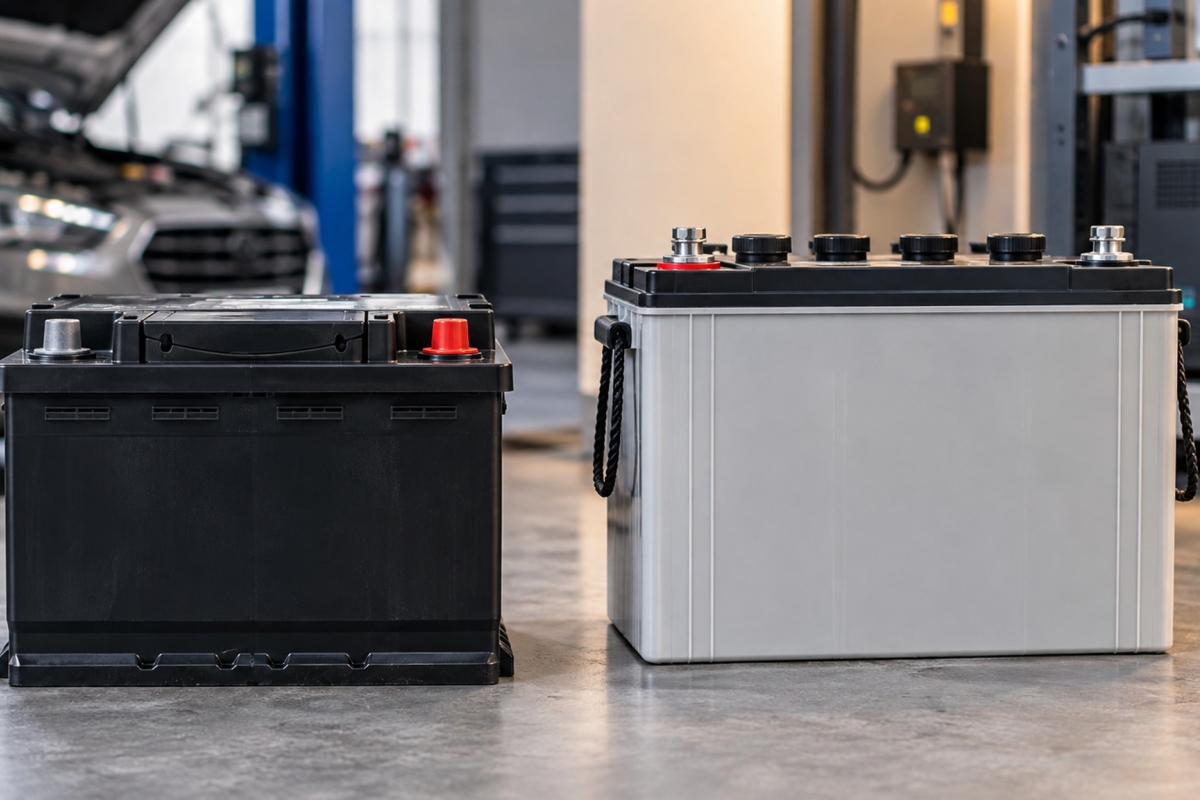
What Is the Difference Between a Stationary Battery and an Automotive Battery (Regular Battery)?
The difference between stationary and automotive batteries lies in the job each one is designed to perform: an automotive battery delivers extremely high current for a few seconds to start the engine, while a stationary battery provides gradual and continuous power for hours, supporting repeated charge and discharge cycles in fixed installations. From the outside, the two may look identical - casing, terminals, 12V. Inside, however, they are designed for opposite purposes. And it is precisely this external similarity that leads to one of the most costly mistakes in the segment: using one in place of the other. In this article, you'll understand the differences in construction, behavior, and application - and why each technology should be used for its intended purpose.
Continue reading

How to Install a Stationary Battery Correctly and Safely
Properly installing a stationary battery involves four key areas: choosing a well-ventilated location protected from heat, making connections in the safe sequence with the correct torque, assembling battery banks only with identical batteries, and adjusting the charger or inverter's float voltage according to the manufacturer's manual. Installation is the moment that determines a significant part of the battery's service life: a properly sized battery installed in a hot location or with incorrect float settings will age in a fraction of its expected lifespan. This guide covers the complete procedure - from preparing the installation site to the final system validation.
Continue reading