How to Install a Stationary Battery Correctly and Safely
Properly installing a stationary battery involves four key areas: choosing a well-ventilated location protected from heat, making connections in the safe sequence with the correct torque, assembling battery banks only with identical batteries, and adjusting the charger or inverter's float voltage according to the manufacturer's manual.
Installation is the moment that determines a significant part of the battery's service life: a properly sized battery installed in a hot location or with incorrect float settings will age in a fraction of its expected lifespan.
This guide covers the complete procedure - from preparing the installation site to the final system validation.

Where to Install a Stationary Battery?
The ideal location is ventilated, dry, and protected from direct sunlight and heat sources, with a temperature as close as possible to the technical reference of 27°C - temperature directly affects battery service life, and each degree above this accelerates self-discharge and wear.
Ventilation is not merely an aesthetic detail: during charging, lead-acid batteries can release gases. The environment needs to dissipate them, and flames, sparks, and cigarettes must be prohibited in the area. The base must be firm and level - shelves and racks must be properly sized for the weight of the battery bank.
Preparation and Safety
- Wear safety glasses and gloves; remove rings, watches, and metal jewelry.
- Work with insulated tools - a wrench coming into contact with both terminals can cause an immediate short circuit.
- Turn off the charger, inverter, or UPS before making any connection.
- Check the battery's condition: no cracks in the casing and clean terminals.
- Keep the manufacturer's manual on hand for the correct voltage parameters.
Step-by-Step Installation
- Position the battery on its final base before connecting any cables.
- Connect the system's positive terminal first, then the negative.
- Apply the recommended torque to the terminals: a loose connection causes heating; excessive tightening can damage the terminal.
- Protect the terminals with suitable grease against oxidation.
- Identify the cables and current direction for future maintenance.
- Only then reconnect the charger or inverter and validate the voltages.
Building Battery Banks: Series and Parallel
In series, the voltages are added together (two 12V batteries form 24V); in parallel, the capacities are added together. Battery banks combine both types of connections to achieve the project's required voltage and autonomy - complete sizing is covered in the Complete Guide to Stationary Batteries.
The non-negotiable rule for battery banks: use batteries of the same model, age, and state of charge. Interconnection cables must have the appropriate gauge and the same length between the rows to distribute the current evenly.
Float Voltage Adjustment: The Detail That Defines Years of Service
The float voltage of the charger, inverter, or controller must follow the battery manufacturer's manual exactly. High float voltage causes overcharging and drying; low float voltage causes undercharging and sulfation - both conditions silently shorten battery life. In solar systems, it is also important to check the controller's charging stages, as detailed in the guide to the stationary battery for off-grid solar energy.
Validation and Post-Installation Maintenance
Once the system is turned back on, measure the float voltage at the terminals and record the initial values - they will serve as a reference for future maintenance. Establish a routine that includes periodic inspection of the terminals, cleaning, voltage checks, and environmental monitoring. Stationary battery failures can occur silently; periodic testing is what ensures that the battery will perform when the power grid goes down, as explained in the article on what a stationary battery is and what it is used for.
Installation Errors That Shorten Battery Life
- Installing the battery near a heat source or under direct sunlight.
- Placing the battery on an unstable or undersized base for its weight.
- Tightening terminals without controlled torque - loose connections cause heating, while excessive tightening damages the terminal.
- Building a battery bank with batteries of different ages.
- Restarting the system without checking the float voltage.
- Failing to identify the cables, making future maintenance more difficult.
Every item on this list can be avoided on the day of installation - and all are among the mistakes that reduce the service life of any battery. One hour of careful installation can provide years of operation.
How Does Tudor Support the Installation?
The Tudor 12TE Stationary line - ranging from 25Ah to 220Ah and approved by ANATEL - comes with its own technical manual containing the official installation, charging, and float voltage parameters, as well as a 24-month warranty. The technical team can also validate your battery bank configuration via WhatsApp before purchase.
Conclusion
Stationary battery installation requires discipline, not improvisation: the right location, a safe connection sequence, the correct torque, a homogeneous battery bank, and properly adjusted float voltage. Each item on the checklist directly contributes to years of service life.
To size and install your system with technical support, visit which Tudor stationary battery to choose and speak with a specialist.
Frequently Asked Questions
What is the correct cable connection order for a stationary battery?
Connect the positive terminal first and the negative last, with the charger or inverter turned off. When disconnecting, reverse the order.
Can a stationary battery be installed in an enclosed environment?
It needs ventilation because charging can release gases. Enclosed environments require air circulation and must be kept away from flames and sparks.
What is the ideal temperature for a stationary battery?
The technical reference is 27°C. Above this temperature, self-discharge and wear accelerate - install the battery away from direct sunlight and heat sources.
Can I mix different batteries in the same bank?
No. Use batteries of the same model, age, and state of charge. Differences between the units can unbalance the bank and reduce the service life of all batteries.
What is float voltage and how should it be adjusted?
It is the voltage maintained by the charger when the battery is in standby mode. The correct value is specified in the battery manufacturer's manual - excessively high or low float voltage shortens battery life.
Do I need an electrician to install a stationary battery?
Simple installations can follow the step-by-step procedure with basic safety precautions. Larger battery banks, solar systems, and high-capacity UPS systems require a qualified professional and an appropriate design.
Can a stationary battery be installed on its side?
Follow the manufacturer's instructions in the manual: the correct operating position preserves the electrolyte and system safety. When in doubt, install the battery vertically.
Read also
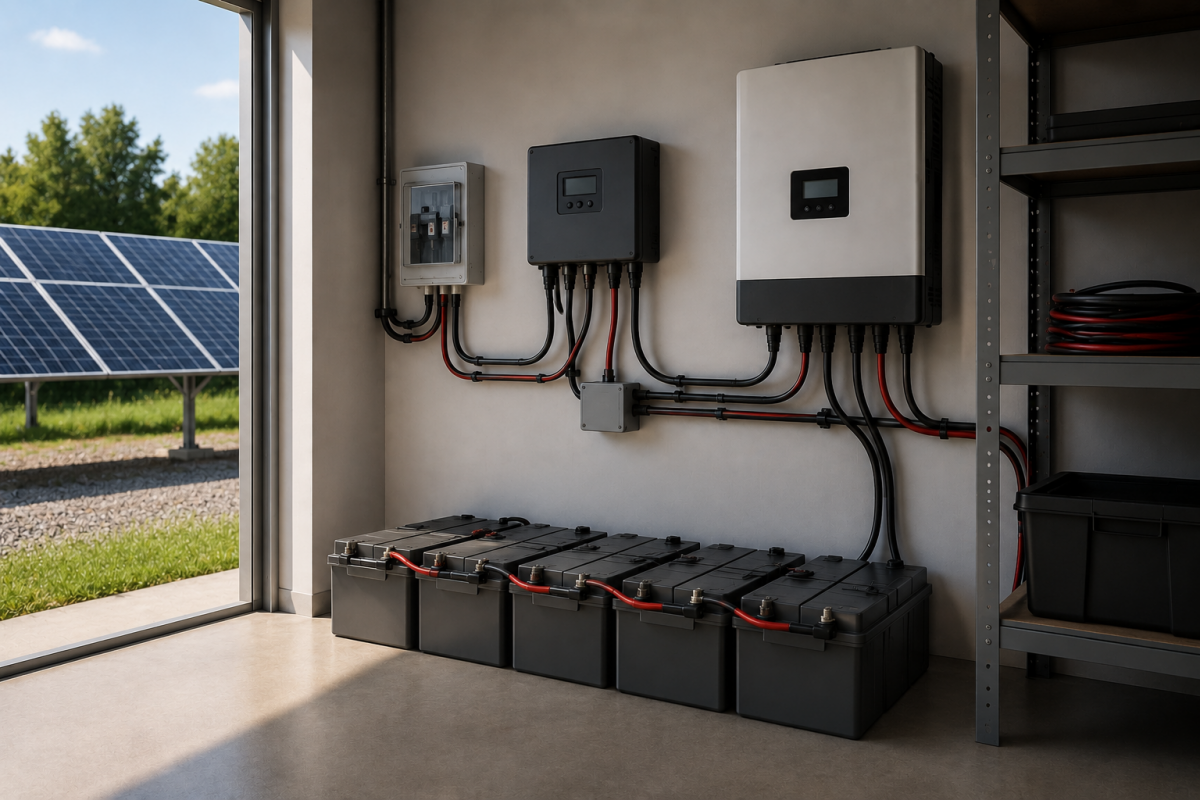
How to Choose the Ideal Stationary Battery for Off-Grid Solar Power
The ideal stationary battery for off-grid solar power is sized in four steps: add the equipment's daily consumption, define the days of autonomy without sun, apply the recommended depth of discharge, and convert the result into capacity (Ah) at the battery-bank voltage. In an off-grid system, there is no utility grid to back up the project: the battery is the only reserve. Tight sizing means running out of power on the second cloudy night; correct sizing means years of quiet, reliable supply. This article walks through the calculation step by step, covering the concepts that make a difference in the result.
Continue reading
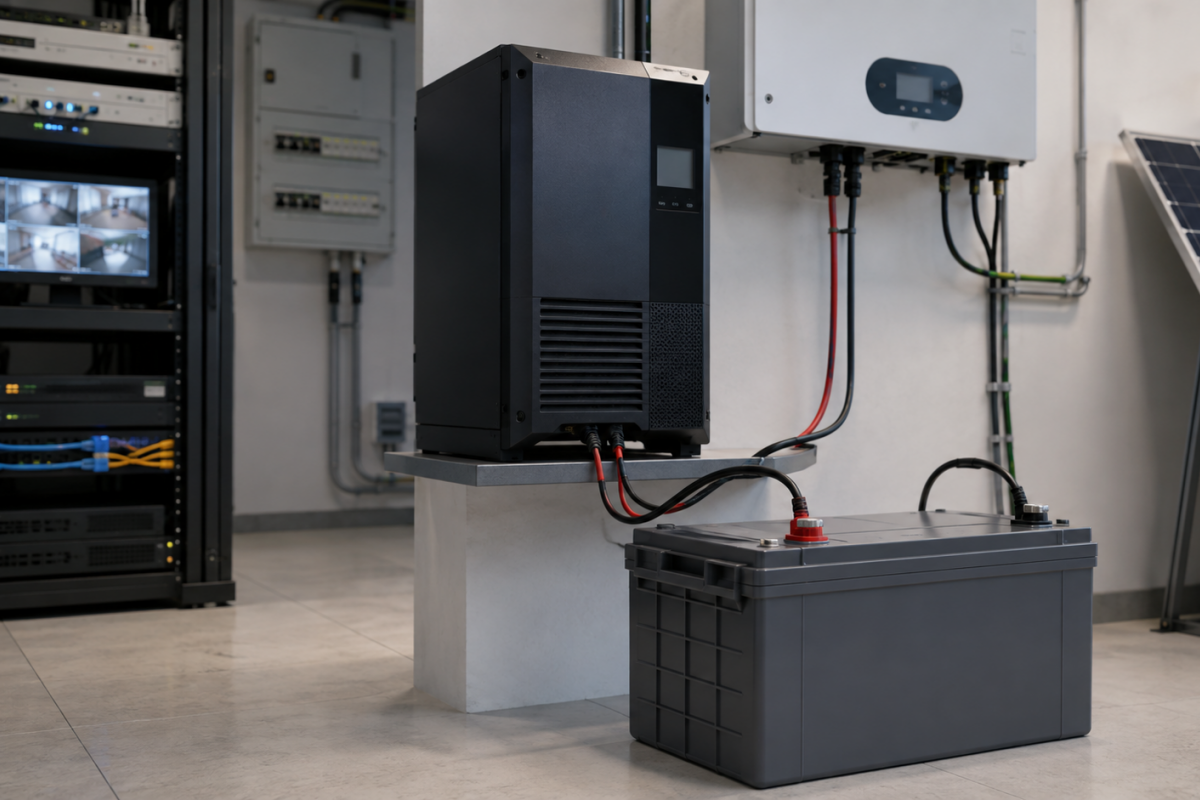
What Is a Stationary Battery and What Is It Used For?
A stationary battery is a battery designed for fixed installations: it provides continuous or backup power and supports repeated charge and discharge cycles. It is used in solar power systems, UPS systems, telecommunications, electronic security, and emergency lighting. The name says a lot: “stationary” because it does not move - unlike a car battery, it works in a fixed position, in a technical room, rack, or cabinet, powering systems that cannot be left without energy. In this article, you will understand how it works, where it is used, and why it should not be confused with an automotive battery.
Continue reading

Complete Guide to Stationary Batteries: types, deep cycle, applications, service life, and how to choose the ideal one
A stationary battery is a battery designed for fixed installations: it provides continuous or backup power and supports repeated charge and discharge cycles. It is a central component of off-grid solar power systems, UPS systems, telecommunications, electronic security, and emergency lighting. Unlike an automotive battery, which delivers high current for a few seconds during starting, a stationary battery works for hours, gradually discharging and then recharging - an operating profile that requires a specific internal construction. This guide explains how a stationary battery works, where it is used, what concepts such as deep cycle and depth of discharge mean, and how to size the right capacity for each project.
Continue reading