What Is a Deep-Cycle Battery? A Simple Explanation
A deep-cycle battery is built to discharge a significant portion of its energy and then recharge, repeatedly, without damaging the plates. It is the technology behind solar-energy systems, marine service batteries, and industrial traction batteries.
The simplest way to understand it: some batteries are made to deliver a shout of energy (engine starting), while others are made to keep talking for hours. Deep-cycle batteries are the second family.
In this article, you will understand the concept without technical jargon, learn what depth of discharge is, and see where this technology works in everyday life.
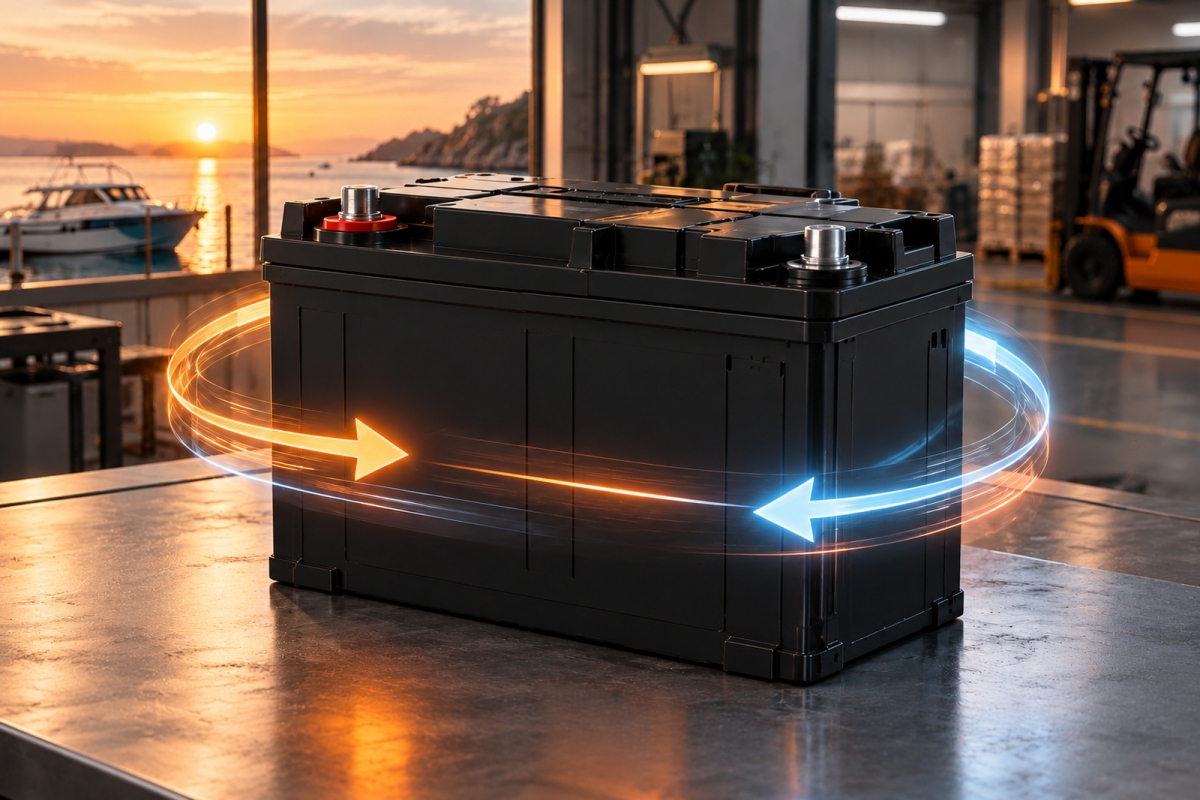
What is a cycle - and what makes it “deep”?
A cycle is the complete path: discharge and recharge. Every battery cycles; the difference is depth. A starting battery uses only a small slice of its energy each time and is immediately recharged. A deep-cycle battery goes deeper - using a large portion of its capacity - and comes back, day after day.
To withstand this, the internal construction changes: plates and alloys sized for a marathon, not a hundred-meter sprint.
Depth of discharge (DoD), without the mystery
Depth of discharge is the percentage of energy used in each cycle. Here is the category’s golden rule: the less deeply you discharge on each cycle, the more cycles the battery delivers over its life. A bank designed to use half its capacity per day lasts far longer than one pushed to the limit - the principle that governs sizing in any project, as shown in the example of a stationary battery for off-grid solar power.
Where are deep-cycle batteries used?
- Solar energy: stores power during the day and delivers it at night - a daily cycle by definition, the heart of stationary batteries.
- Marine: powers onboard equipment for hours, as explained in the article about the deep-cycle marine battery.
- Industry: the extreme end of the category - traction batteries discharge deeply through an entire shift while moving forklifts.
- UPS and telecom: backup cycles combined with long periods of float operation.
Deep-cycle vs. starting battery
A starting (automotive) battery delivers extremely high current for seconds and hates deep discharge - a few full discharges can be enough to damage it. A deep-cycle battery delivers moderate current for hours and is built to go down and come back. Both exist in the portfolio because they do opposite jobs - the full comparison is in stationary battery vs. automotive battery.
Is a deep-cycle battery the same as a sealed battery?
No - and the confusion is common. “Sealed” describes the construction (maintenance-free, with no electrolyte top-up); “deep-cycle” describes the duty cycle (repeated significant discharges). There are sealed starting batteries and vented deep-cycle batteries: the two concepts can be combined, but they are not interchangeable. When buying, the right first question is always what work the battery will do - and only then how it is built.
The same applies to other market labels such as “high durability” or “heavy duty”: none replaces the information that really matters - what discharge regime the battery was designed for and how deeply your system will discharge it every day.
How do you care for a deep-cycle battery?
- Respect the project’s depth of discharge: discharge less deeply, last longer.
- Recharge fully after use - chronic partial recharges shorten service life.
- Control ambient temperature: the technical reference is 27°C.
- Use a charger or controller set to the manufacturer’s parameters.
- Perform periodic testing: deep-cycle batteries also age, just quietly.
How does Tudor apply deep-cycle technology?
The concept runs across the Tudor portfolio: the 12TE Stationary line for solar, UPS, and telecom; the dual-purpose Marine line for starting and onboard service; and the Traction line for industrial duty. The complete technical foundation of the stationary category is in the Complete Guide to Stationary Batteries.
Conclusion
Deep-cycle is the engineering of consistency: energy delivered gradually, for hours, day after day. Understanding the concept - and depth of discharge - is the first step in sizing any system that depends on a battery doing real work.
To find out which deep-cycle battery your project needs, see how to choose the ideal stationary battery and talk to a Tudor specialist.
Frequently Asked Questions
What does deep-cycle battery mean?
It is a battery built to discharge a significant portion of its capacity and recharge repeatedly without damaging the plates - unlike a starting battery, which is designed for brief, shallow discharges.
What is depth of discharge (DoD)?
It is the percentage of energy used in each cycle. The lower the average discharge depth, the more cycles the battery delivers over its life.
Is a car battery a deep-cycle battery?
No. An automotive battery is a starting battery: it delivers very high current for seconds and does not tolerate repeated deep discharges.
Where are deep-cycle batteries used?
In solar energy, stationary systems (UPS, telecom, security), marine service batteries, and industrial traction batteries for forklifts.
How many cycles does a deep-cycle battery last?
It depends on depth of discharge, temperature, and recharge quality. Projects that discharge less deeply per cycle multiply total service life.
Is every sealed battery a deep-cycle battery?
No. Sealed describes maintenance-free construction; deep-cycle describes a repeated-discharge duty. The concepts are independent and may or may not be combined in the same product.
Read also
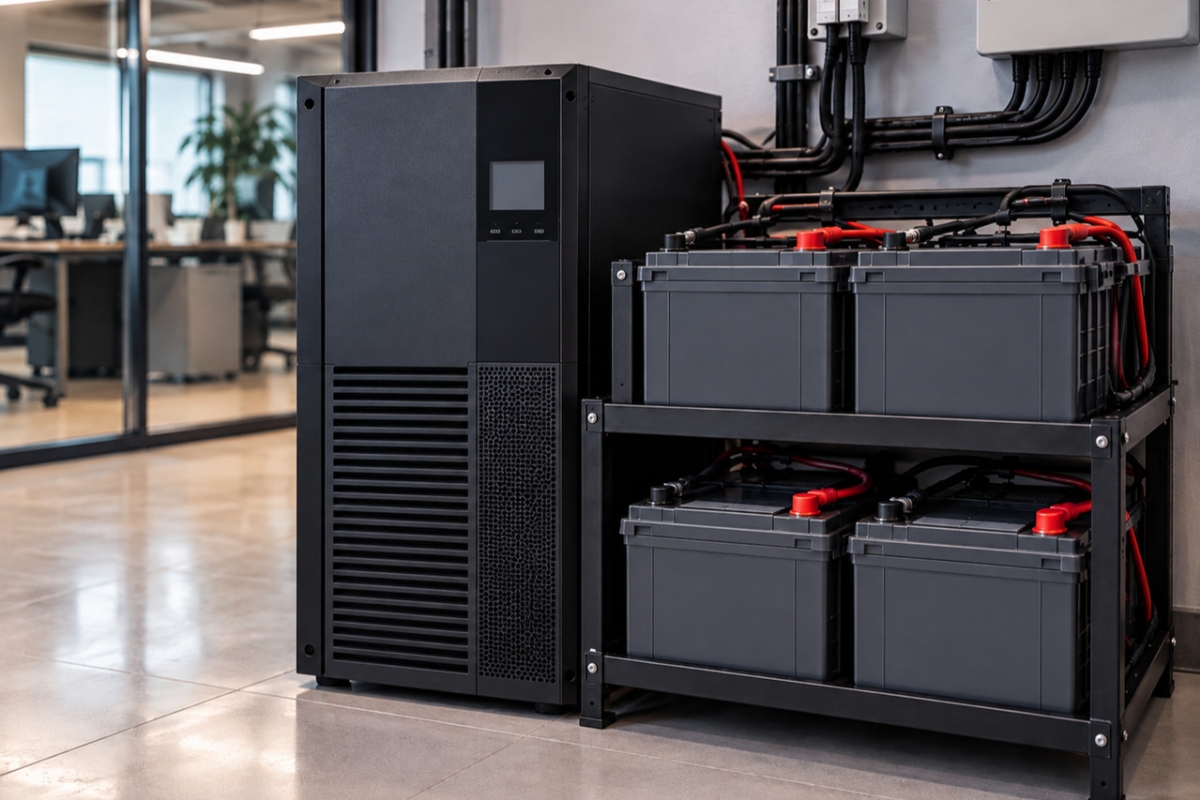
Stationary Battery for a UPS: How to Size the Required Runtime
To size the stationary battery for a UPS, add up the power of the protected equipment (W), define the desired runtime in hours, calculate the energy (Wh = W × hours), and convert it to capacity by dividing by the battery-bank voltage - applying margins for depth of discharge and temperature. A UPS without a properly sized battery is an empty promise: it may keep the power on for minutes when the project needed an hour. The opposite also costs money - capacity far beyond what is needed is idle investment. This guide walks through the calculation step by step, with a practical example and the mistakes that reduce real runtime.
Continue reading
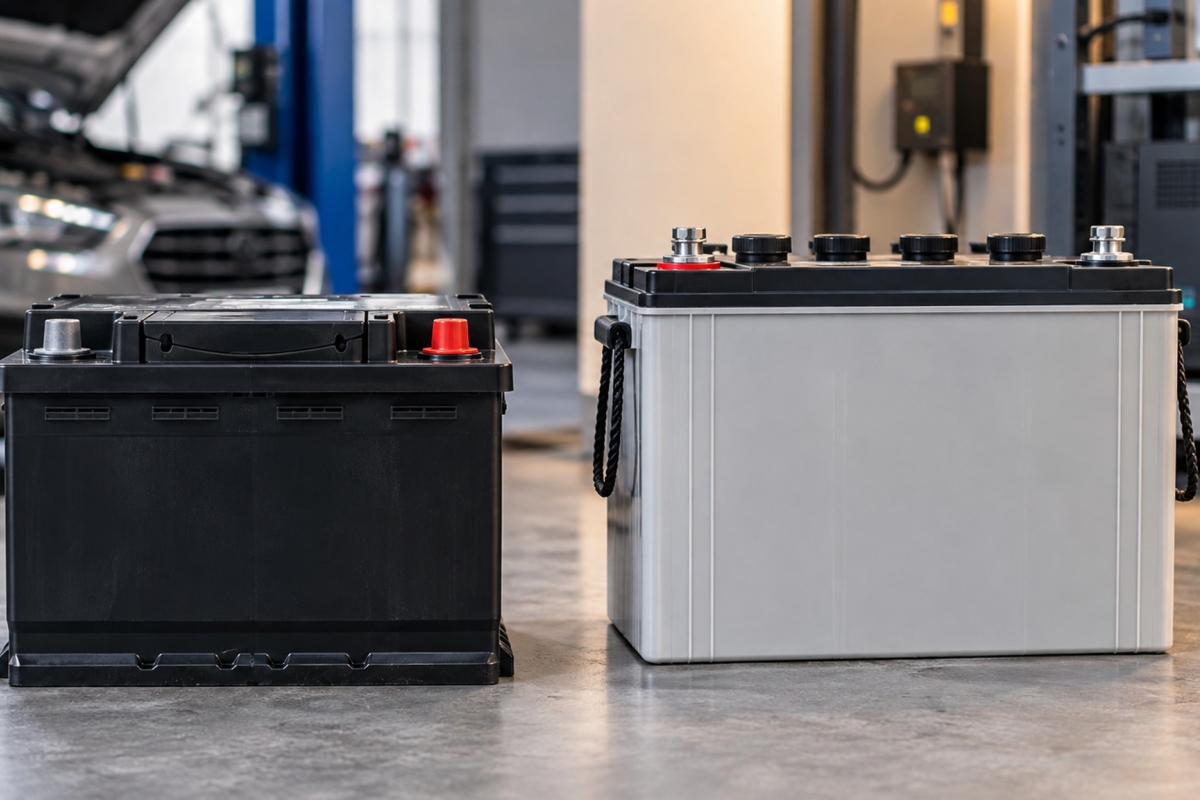
What Is the Difference Between a Stationary Battery and an Automotive Battery (Regular Battery)?
The difference between stationary and automotive batteries lies in the job each one is designed to perform: an automotive battery delivers extremely high current for a few seconds to start the engine, while a stationary battery provides gradual and continuous power for hours, supporting repeated charge and discharge cycles in fixed installations. From the outside, the two may look identical - casing, terminals, 12V. Inside, however, they are designed for opposite purposes. And it is precisely this external similarity that leads to one of the most costly mistakes in the segment: using one in place of the other. In this article, you'll understand the differences in construction, behavior, and application - and why each technology should be used for its intended purpose.
Continue reading

How to Install a Stationary Battery Correctly and Safely
Properly installing a stationary battery involves four key areas: choosing a well-ventilated location protected from heat, making connections in the safe sequence with the correct torque, assembling battery banks only with identical batteries, and adjusting the charger or inverter's float voltage according to the manufacturer's manual. Installation is the moment that determines a significant part of the battery's service life: a properly sized battery installed in a hot location or with incorrect float settings will age in a fraction of its expected lifespan. This guide covers the complete procedure - from preparing the installation site to the final system validation.
Continue reading